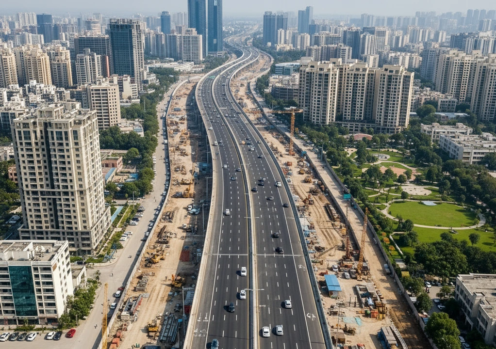
The Faridabad–Noida–Ghaziabad (FNG) Expressway is a major upcoming infrastructure project designed to significantly improve regional connectivity across NCR. The expressway is planned to span around 56 kilometres, of which nearly 20 km will pass through Noida–Greater Noida, about 8 km through Ghaziabad, and roughly 28 km through Faridabad. If the alignment is later extended to nearly 75 km, areas around Sohna Road are also expected to see a strong positive impact on real estate activity.
Anticipating long-term growth even before the project’s completion, real estate developers have started focusing on this corridor. Several residential and mixed-use projects are being planned, aimed at offering modern housing options at relatively competitive prices. The improving infrastructure has made the FNG belt an emerging destination for both end-users and investors.
Connectivity with nearby regions
The FNG corridor strengthens direct connectivity between Faridabad, Noida, Greater Noida, and Ghaziabad, reducing dependence on congested routes such as NH-24 and NH-2. Rail connectivity to other parts of the country is supported through nearby New Delhi and Hazrat Nizamuddin railway stations. Once operational, the expressway will allow smoother inter-city movement without passing through central Delhi.
Social infrastructure and education
The areas along the FNG Expressway are supported by established educational institutions and civic amenities. Well-known schools such as Apeejay School and Modern School cater to local residents, while higher education options include institutions like YMCA University of Science and Technology and Lingaya’s University. These facilities enhance the livability of the region and support residential demand.
Employment hubs and economic prospects
Faridabad has long been an industrial base, and the FNG Expressway is expected to further strengthen its economic potential. The region hosts large manufacturing and engineering companies along with nearly 25,000 small-scale industrial units. Alongside manufacturing, future growth is expected in IT and service-oriented industries, making the corridor attractive for professionals seeking housing close to workplaces.
Physical infrastructure advantages
The expressway project is expected to benefit over 2.2 lakh vehicles daily by offering an efficient alternative route between major NCR cities. Travel time between Ghaziabad and Faridabad is likely to reduce to around 40 minutes, compared to nearly two hours at present. This will also ease traffic congestion on existing highways such as NH-58, NH-24, and NH-2 within the Delhi region.
Property price trends
Residential property prices along the FNG Expressway currently range between approximately Rs 5,000 and Rs 6,000 per sq ft. Plot prices are in the range of about Rs 2,970 to Rs 3,710 per sq yard, making the corridor relatively affordable compared to more saturated NCR locations.
Why investing in the FNG Expressway makes sense
With steady infrastructure development and improving connectivity, the FNG Expressway region is emerging as a strong investment destination. One of its biggest advantages is the ability to travel between Ghaziabad, Noida, Faridabad, and Gurgaon without entering Delhi, significantly reducing commute stress. As traffic congestion continues to challenge existing routes, this expressway is expected to drive residential growth and transform nearby localities into prominent housing and investment zones.
Overall, the Faridabad–Noida–Ghaziabad Expressway is poised to play a crucial role in shaping the future real estate landscape of NCR, offering a blend of connectivity, affordability, and long-term growth potential.